If you had asked me a year ago what I knew about collector plates, I would have told you almost nothing. That changed the day I bought a lot at auction and ended up with a stack of beautifully decorated porcelain plates — some stamped Franklin Mint, some stamped Edwin M. Knowles. That single auction purchase pulled me headfirst into a world I never expected to find myself in.
Here is what I have learned so far about these two iconic names and what made them stand out in the collector plate market.
Two Very Different Backgrounds
The Franklin Mint was established in 1964 and began by producing and selling privately minted gold and silver commemorative rounds and medallions. Throughout the 70s, 80s, and 90s, the company continuously expanded into new collectibles areas, including figurines, plates, die cast models, and pewter. The Franklin Mint issued its first collector plate in 1970 — a Norman Rockwell Christmas plate made of sterling silver. From the very beginning, Franklin Mint positioned itself as a premium brand rooted in precious metals and high-end production. MifioLoveToKnow
Edwin M. Knowles has a very different story. Edwin M. Knowles was born in 1869, the son of Isaac Watt Knowles, founder of one of the largest American pottery companies at the turn of the 20th century. Edwin founded the Knowles China Company in 1900, with manufacturing centered in Chester, West Virginia, later expanding to Newell, WV. Edwin died in 1943, and the company folded in 1962. Here is the part that surprises most people: in the 1980s and 90s, the Edwin M. Knowles name resurfaced, copyrighted by a group with no connection to the original company. This new iteration of Edwin M. Knowles created and sold collectible plates, often depicting scenes from famous films and other licensed properties. The Bradford Exchange bought the rights to the Knowles name and used it as a backstamp on collector and limited edition plates. These plates were manufactured offshore and not in America. Digital Chicago + 2
So while both names carry weight in the collector plate world, one was a vertically integrated American manufacturer from the start, and the other was a beloved heritage name that was essentially licensed and revived for the collectibles boom.
What Made Them Leaders
Both brands understood one thing better than almost anyone else in the market: collectors want to feel like they own something rare and meaningful.
Franklin Mint leaned hard into craftsmanship and prestige. Many Franklin Mint collector plates are individually hand-numbered, and their use of precious materials — including 24K gold borders and sterling silver — gave buyers the sense that they were purchasing fine art, not just decorative dishes. The brand built trust over decades by delivering consistent quality across a huge range of product categories. LoveToKnow
Knowles, on the other hand, dominated through licensing and storytelling. Their plates tied into things people already loved — movies, musicals, wildlife, American nostalgia. Each plate came with a certificate of authenticity and was strictly limited to a set firing period, permanently closed on a date certain. That sense of urgency and exclusivity drove collectors to buy entire series, not just single plates. Series like the Sound of Music plates were endorsed by the estates of the original creators, lending them a cultural legitimacy that went beyond the porcelain itself. WorthpointInstAppraisal
The Bradex Factor
One of the first things I noticed when digging into my auction lot was a mysterious number stamped on the back of the Knowles plates. That turns out to be the Bradex number — a tracking system developed by the Bradford Exchange to catalog and assign secondary market values to collector plates. Each plate in a series carries its own Bradex number, and the Bradford Exchange published current quotations showing both the original issue price and the current market quote. For collectors, this was essentially a stock ticker for their shelves. It gave the hobby a sense of financial legitimacy and encouraged people to treat their plates as investments. Worthpoint

Franklin Mint had its own authentication system — hand-numbering, certificates of authenticity, and the Heirloom Recommendation designation — but it did not lean on the Bradex system the way Knowles did. That difference says a lot about who each brand was selling to. Franklin Mint spoke to the prestige buyer. Knowles, through Bradford Exchange, spoke to the everyday collector who wanted to track value over time.
Are They Really That Different?
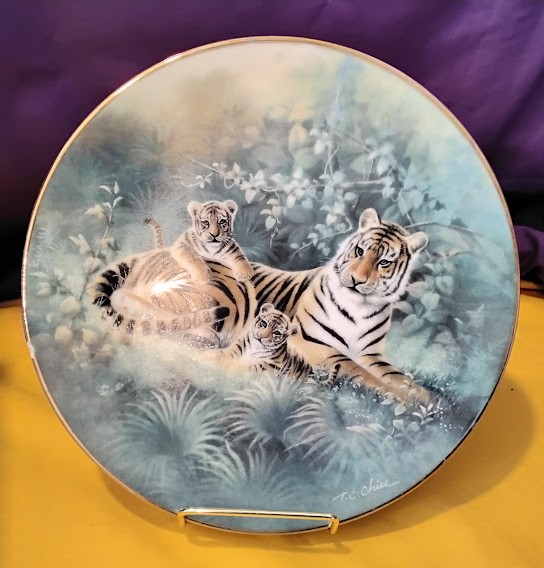
Honestly? After handling plates from both brands, I am not sure the quality difference is as dramatic as the marketing might suggest. Both produced attractive porcelain plates with detailed artwork and decorative borders. Both came with certificates and limited edition numbering. Both made wildlife a central theme — tigers, birds, and North American animals were hugely popular subjects for both companies during the late 1980s and early 1990s.
Where they differ is in their brand identity and how they reached their audience. Franklin Mint felt like a luxury goods company that happened to make plates. Knowles felt like a storytelling company that used plates as the medium. Neither is better or worse — they were just speaking to slightly different collectors.
What New Collectors Should Know
I stumbled into this world through an auction lot, and I suspect a lot of people come to collector plates the same way — unexpectedly. If that is you, here is what I would keep in mind:
- Check the back of the plate carefully. The backstamp, Bradex number, plate number, and certificate language tell you almost everything you need to know about what you have.
- Original packaging and certificates of authenticity matter. Particularly pristine items are worth more, especially those with intact original packaging, the original certificate of authenticity, and other documentation. Mifio
- Do not assume the name alone means value. Most Franklin Mint plates sell for under $10, but a few special ones can be worth hundreds. The same is true for Knowles plates. The name is a starting point, not a guarantee. LoveToKnow
- Condition is everything. A plate with chips, cracks, or fading loses most of its appeal to serious collectors regardless of the brand.
- Most importantly — enjoy the discovery process. These plates tell a story about American pop culture, wildlife conservation interest, and the collectibles craze of a specific era. That story is worth understanding even if the plates themselves are not worth a fortune.
I am still early in my journey with these pieces. But that auction lot was one of the better surprises I have had, and it sent me down a rabbit hole I did not expect. There is a lot more to learn, and I plan to keep sharing what I find along the way.
Comments